
GOP Plan Would Cut Medicaid By $1.7 Trillion, Study Says
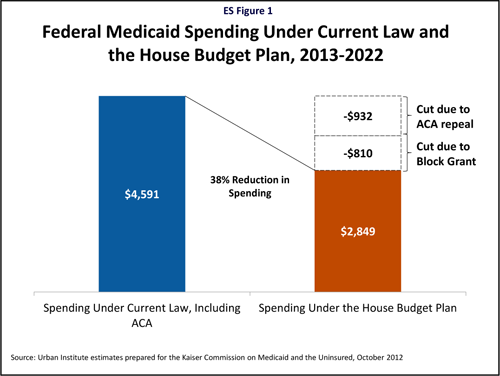
The House Republican plan to repeal President Barack Obama鈥檚 health law and turn Medicaid into a block grant program would save the federal government $1.7 trillion from 2013 to 2022, a 38-percent spending reduction, by the Urban Institute for the Kaiser Family Foundation.
It would also result in 31 million to 38 million fewer people聽getting Medicaid coverage in 2022, according to the report. The entitlement program, which is jointly financed by the state and federal governments,聽now provides health coverage to about 62 million poor people, about half聽of whom are children.
The block grant idea 鈥� paying a fixed sum to states — was 51视频ted by Rep. Paul Ryan, Mitt Romney鈥檚 vice presidential聽running mate聽and chair of the House Budget committee, and passed by the Republican-controlled House of Representatives in 2011 and 2012. The strategy is part of the GOP plan to cut the nation’s聽$1 trillion federal deficit.
block grant strategy that would cut $100 billion a year from Medicaid starting in 2013. Under Romney鈥檚 plan,聽federal payments to the states for Medicaid would grow at 1 percentage point a year above the Consumer Price Index. That would slow funding increases, but give states greater freedom in how they use the money, including the ability to cut eligibility or benefits to meet their budget needs. Today, the federal government sets minimum rules and guidelines and must approve any major changes to the program.
The Urban Institute analysis, which updates an analysis originally done in May 2011, 聽said the House block grant plan would cut funding to hospitals by as much as $363.8 billion, and聽payments to nursing homes by $22.2 billion.
Of the $1.7 trillion cut to Medicaid spending, $932 billion of the reductions come from repealing the Medicaid expansion in Obama鈥檚 health law and $810 billion is a result of spending cuts that are part of the block grant.
, Medicaid聽would expand to cover as many as 17 million more people starting in 2014. States have the option to decide whether to expand eligibility, and several Republican-led states including Florida and Texas聽say they can鈥檛 afford the expansion.


