Aimee Carlock needed surgery in August 2025 to treat severe pain and bleeding from her uterus. But first, she needed to come up with $5,500.
Texas Health Resources, one of the state’s largest nonprofit hospital systems, told her it wouldn’t schedule the procedure unless she paid up front, Carlock said. The self-employed house cleaner didn’t have the money.
“I panicked because I live paycheck to paycheck,” she said. “I have no extra money whatsoever.”
Carlock borrowed cash from her best friend and parents. Her father offered money he inherited when Carlock’s grandfather died a few years ago.
Only after the surgery did Carlock, 35, learn she qualified for hospital financial aid. Her care should have been free, but the system doesn’t give full refunds. The $5,500 was gone.
Carlock’s poor health has kept her out of work most of this year. She took out loans for groceries and utilities and applied for food stamps. It will take years, she said, to chip away at what she owes.
“I’m just trying to pick myself back up,” Carlock said. “But it’s really hard.”
Hospitals have a tool to automatically screen people like Carlock for financial aid and grant them relief — a process known as . But if, when, and how hospitals deploy this tool is largely up to them; there are few state or federal requirements.
A found that in Texas nearly half of nonprofit hospitals say they will bill patients before screening them for financial aid. And most hospitals will not offer refunds to patients who pay and are eventually found to qualify for free care.
Many patients are unaware that hospitals offer financial help, often known as charity care. Others are stymied by onerous applications that require people to turn over financial information, such as bank statements, car notes, pay stubs, retirement accounts, and even divorce records.
“It’s like going through a tax audit,” said Stanford University health economist Neale Mahoney, who studies medical debt. “The current system is broken.”
An estimated 100 million adults in the U.S. have healthcare debt, according to a 51ÊÓƵ Health News analysis. That includes amounts people owe to hospitals and doctors, as well as loved ones, credit card companies, and banks. This debt can be life-altering, forcing people to take on additional jobs, push off retirement, or cut back on essentials like groceries and medical care.
Tradeoffs analyzed the financial assistance policies of all 166 nonprofit general hospitals and children’s hospitals in Texas, which has than .
The analysis is believed to be the first detailed look at presumptive eligibility policies of nonprofit hospitals, which . They get these tax breaks in exchange for , such as financial assistance. and in have questioned whether nonprofits do enough to earn those tax breaks.
Since 2020, a , including Texas, have debated or adopted requirements for hospitals to use presumptive eligibility in financial assistance to protect patients from avoidable debt.
“This is clearly an industry that is not policing itself very well,” said Tom Oliverson, a physician and Texas lawmaker who has proposed legislation to require hospitals to screen patients before sending a bill.
Automatic screening is a good option to help some patients, said Anna Stelter, vice president of policy at the Texas Hospital Association. But often, she said, there are other payment options, such as insurance, which hospitals need to pursue first. “Charity care is the relief of last resort,” she said.
Most Texas Hospitals Can Automatically Give Help
To identify nonprofit hospitals in Texas, Tradeoffs consulted state and federal records and a list of hospital policies maintained by , a group that helps patients apply for financial assistance. To verify policies were up to date, Tradeoffs scoured websites, often clicking through multiple links to find policies. When policies were missing, Tradeoffs reached out directly to hospitals and filed public records requests with the state, which requires hospitals to submit policies annually.
Tradeoffs’ analysis found that nearly every Texas nonprofit hospital can screen and proactively reduce bills when patients are found eligible for help.
Nationally, around 90% of nonprofit hospitals reported the same in 2022, according to an analysis of federal data for Tradeoffs by the independent research institute RTI International. That’s up from 72% six years earlier.
Hospitals’ use of automatic financial aid , in part, to the Affordable Care Act, which added protections for patients. The law created for hospitals that aggressively go after payment without trying to identify whether patients need help. Presumptive eligibility is .
Covenant Health, a five-hospital system based in Lubbock, was the only system in Texas to say it does not automatically grant financial aid, though its policy allows it.
Covenant doesn’t use the option “due to the regulatory requirements and administrative complexities,” said Ainsley Nelson, the system’s spokesperson. “Our focus continues to be ensuring compassionate access to care and helping patients navigate the financial assistance options available to them.”
Bill First or Screen First?
About 8% of hospitals in Tradeoffs’ analysis have policies that require screening patients for charity care before sending a bill.
Far more, 41%, say they screen patients before turning unpaid bills over to debt collectors or taking , such as garnishing wages, placing a lien on property, or denying further care without payment.
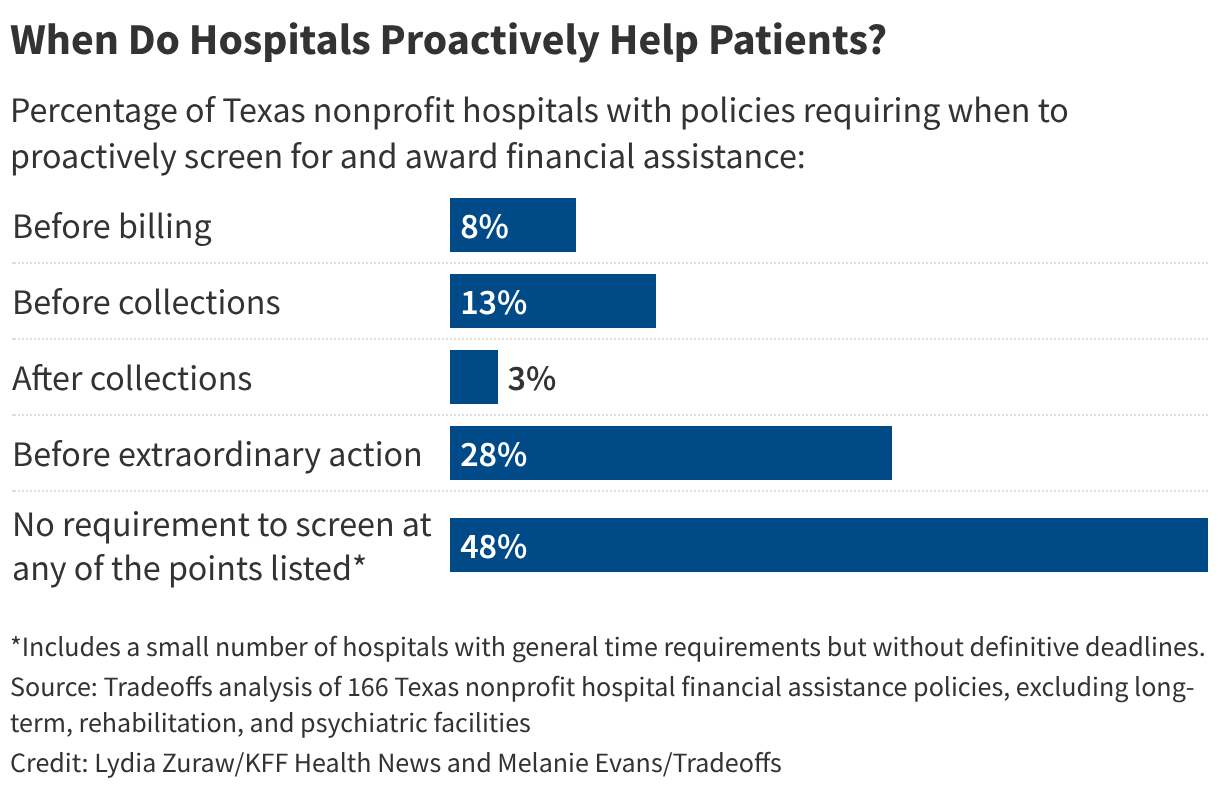
Southeastern Texas hospitals owned by , for example, will automatically wipe out bills only “after all other eligibility and payment sources have been exhausted,” according to its Texas financial assistance policy.
CommonSpirit declined an interview request.
Research shows the sooner patients get financial aid, the better it is for their health.
found that people were more likely to be diagnosed and treated for conditions like depression and diabetes and make follow-up appointments when they received financial aid within weeks of receiving care. of people who had medical debts wiped out after months or years found no health benefit from the relief.
The signal is clear, said Ray Kluender, an associate professor at Harvard University, who worked on both studies. “The timing of when financial assistance is provided by a hospital is just extraordinarily important.”
Some hospitals told Tradeoffs that what they do isn’t always written in policy. For example, spokespeople for and say their systems screen some patients before sending bills — though their policies include no requirement to do so.
When hospitals do wipe out patient costs after sending bills, about 40% say they will not inform patients their balance has been cleared. Just 8% require notification, and the rest say nothing about it in their policies.
“Patients will not be notified to inform them of this decision,” reads CommonSpirit’s policy.
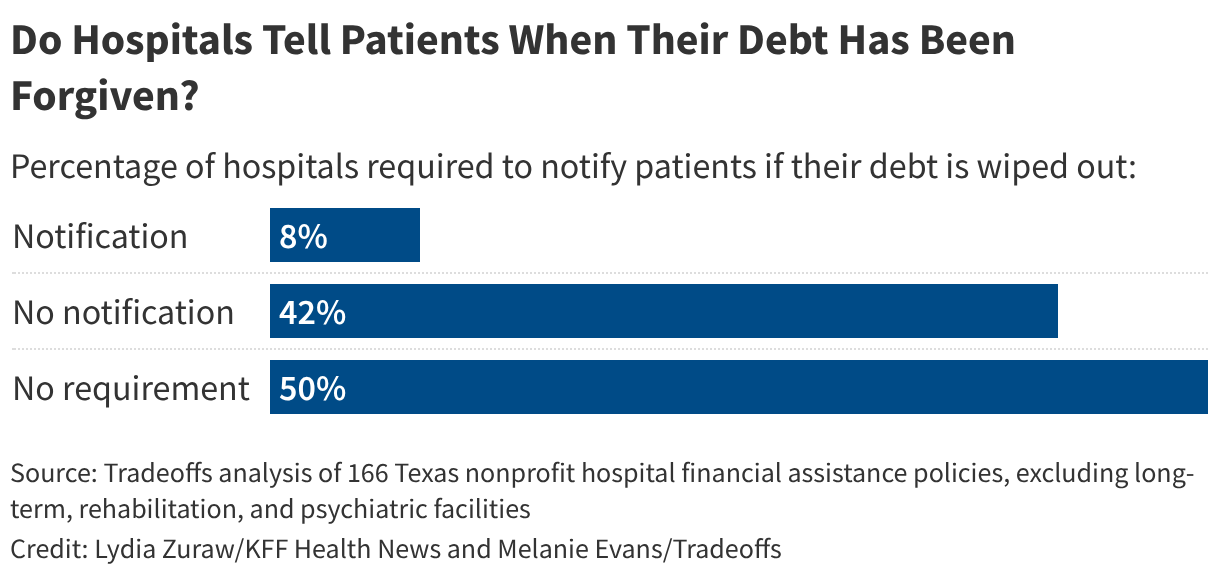
Stelter, with the Texas Hospital Association, said many hospitals have limited staff in their billing departments and would likely prioritize helping patients apply over notifying those who already got help.
“It’s cruel to not notify someone,” said Erin Fuse Brown, a Brown University professor who studies medical debt. “Not to give them the closure to say you can spend that money elsewhere. You can buy your groceries this month. You can fill your prescription because you don’t have to budget for this.”
People with medical debt are three to four times as likely to delay future physical and mental healthcare as people without medical debt, a .
Hospitals Want To Help Patients — And Get Paid
Texas has for decades required nonprofit hospitals to meet one of a few they give patients — one of which is spending at least 4% of their annual patient revenue on charity care.
Research has found such spending targets have had mixed results. Some hospitals helped more patients, and others spending or , including training doctors and subsidizing money-losing but essential services.
The Texas Hospital Association in the state offers presumptive eligibility, but Stelter said screening tools can be unreliable.
Before they grant aid, hospitals want to know if a patient might be among the narrow population of adults who or if a grant might cover their bills — a determination that can require additional time and information.
Stelter also said that providing aid before sending bills could let insurers off the hook. Patients with insurance typically must spend some money before insurers pitch in, known as a deductible. Insurers can hold down consumers’ monthly premiums by raising deductibles, which have climbed to an average of for job-based coverage and for people on marketplace plans.
If they know hospitals will pick up the tab, “what incentive does an insurer have to lower a deductible?” Stelter said.
Hospitals nationwide are expected to come under since Congress reduced subsidies for many people buying health insurance through the Affordable Care Act, and are expected to push millions of low-income Americans .
That policy shift leaves hospitals to pick up more of the safety net, which they can’t afford, said Jill Horwitz, a Northwestern University health policy professor.
“It would be wonderful if nonprofit hospitals could solve the problem of Americans being uninsured or underinsured by paying for the free care,” Horwitz said. “But nonprofit hospitals do not have the money to solve what is ultimately a major federal problem.”
‘You Had To Pay It’
Becca Wahl said she knew nothing about financial assistance when she landed in Memorial Hermann Katy Hospital last October with a concussion after fainting in a Walmart.
“I just thought you had a bill and you had to pay it,” said the 33-year-old uninsured yoga instructor.
So when Wahl saw the $38,000 tab for her emergency room visit, she panicked. The bill was more than she makes in a year.
“I thought, ‘I’m doomed,’” Wahl said. “I just went out to get a birthday card and fell over. And now I have $38,000 of debt.”
Shortly afterward, the hospital called and revised her bill, offering its price for patients who pay cash, she said. That left Wahl with $11,000 in debt and a $1,000-a-month payment plan — better than $38,000, but still out of reach.
Desperate, Wahl went online and found Dollar For, which helps patients apply for financial aid. One week after Dollar For submitted Wahl’s application, Memorial Hermann wiped out her bill.
Memorial Hermann’s policy says its hospitals should screen patients for financial assistance before sending a bill.
Wahl agreed to waive her patient privacy rights so Memorial Hermann could talk about her case. But the hospital declined an interview request. A spokesperson told Tradeoffs that Memorial Hermann is “dedicated to ensuring that every patient has access to clear information about the expected costs of services, and available coverage options and our financial assistance program.”
Wahl is just glad that she doesn’t have to put her life on hold while she pays off that debt.
“The amount of stress that was lifted off of my shoulders by finding out that this medical debt was forgiven was huge,” she said.
Few Hospitals Give Refunds
Some patients who pay down their bills before hospitals wipe them out never get their money back, Tradeoffs found.
Roughly 2 in 3 nonprofit hospitals in Texas have policies that say patients won’t receive full refunds.
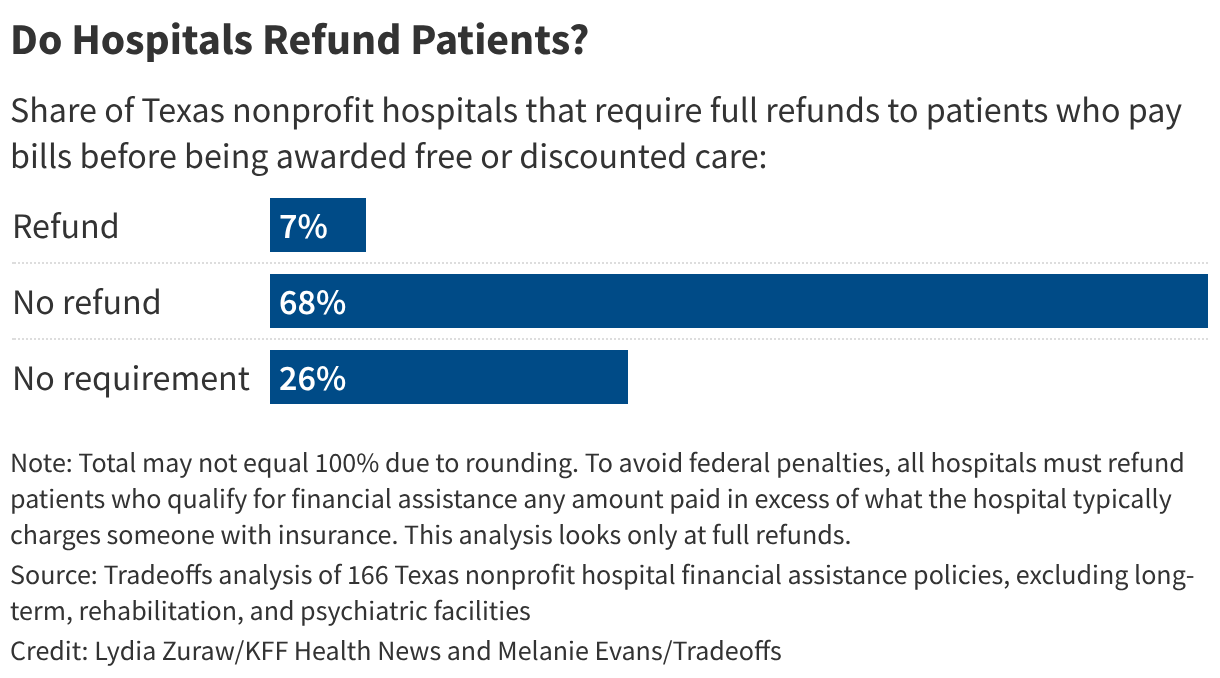
CommonSpirit’s policy has no requirement to refund patients who get automatic financial aid. Felicity Simmons, a system spokesperson, said in an email clarifying its policy that “refunds are case specific.”
A few hospitals say they will return amounts that exceed what the — a federal requirement for all facilities. That is the case at Texas Health, where Carlock paid $5,500 up front for her uterine surgery, before the hospital wrote off the rest of her bill.
Carlock’s $5,500 stayed with the hospital.
Carlock agreed to give Texas Health permission to speak with Tradeoffs about her bill. Texas Health didn’t respond.
Stelter with the Texas Hospital Association said hospitals follow for refunding patients. Those regulations require hospitals to fully refund some patients who submit an application. The rules don’t apply to those who got help through presumptive eligibility, experts on the regulation told Tradeoffs.
States Seek Standards
By July 2027, six states will require hospitals to use presumptive eligibility for certain patients: , , , , , and
Oregon has arguably one of the most aggressive approaches. Starting in July 2024, hospitals had to screen anyone who owes more than $500 and every patient who is on Medicaid or uninsured — . Lawmakers in 2026 amid and the law’s impact on hospital finances.
Hospitals in Oregon more than doubled the amount of charity care they provided, on average, during their first full year under the law, Tradeoffs found. That’s based on an analysis of available Medicare data from roughly two-thirds of hospitals. At OHSU Hospital in Portland, one of the state’s largest, the percentage of patients receiving financial aid jumped from 12% before the law .
In Texas, state representative Oliverson, a Republican, hopes his state will go even further than Oregon. He proposed legislation in 2025 that would require nonprofit hospitals to screen patients and provide aid before sending bills. Those that don’t would face penalties.
The legislation failed, but Oliverson said he plans to reintroduce it in 2027. The lawmaker said nonprofits are falling short of their obligations.
“If you’re sending bills to people that you know when you finally get around to screening them for charity they’re not going to be obligated to pay,” he said, “that should be grounds for losing your tax-exempt status.”
Oliverson said hospitals that already care for a higher share of low-income patients would be exempt from his proposed requirements. But he’s adamant that most nonprofit hospitals should be doing more to protect patients from unnecessary debt.
“If you’re advertising that you’re willing to accept uninsured patients and that you have a charity program,” Oliverson said, “you got to deliver on that.”
This story is part of , an investigative series from and 51ÊÓƵ Health News about how hospitals can protect their patients from the life-altering harms of medical debt. Read our full .
Melanie Evans is a reporter for Tradeoffs, a nonprofit newsroom reporting on healthcare’s toughest choices. to get the latest stories every Thursday morning.
Tradeoffs’ reporting for this series was supported, in part, by the California Health Care Foundation, the National Institute for Health Care Management Foundation, and the Solutions Journalism Network.
51ÊÓƵ Health News is a national newsroom that produces in-depth journalism about health issues and is one of the core operating programs at 51ÊÓƵ—an independent source of health policy research, polling, and journalism. Learn more about .